


What are cell(s) on an HFC Catalytic Converter?


Thread Starter
Registered User
Joined: Aug 2010
Posts: 991
Likes: 5
From: Philadelphia
What are cell(s) on an HFC Catalytic Converter?
In one of my other posts, there is this reference:
Invidia - 100 cell
Berk, ERZ, Stillen (I think) - 200 cell
Kinetics (i think) - 250 cell
FI, Exoticspeed (very pretty) - 300 cell
Silly question perhaps, but what on earth does a cell mean?
Invidia - 100 cell
Berk, ERZ, Stillen (I think) - 200 cell
Kinetics (i think) - 250 cell
FI, Exoticspeed (very pretty) - 300 cell
Silly question perhaps, but what on earth does a cell mean?

Thread Starter
Registered User
Joined: Aug 2010
Posts: 991
Likes: 5
From: Philadelphia
Thanks, so for best gains the Invidia in this example would be best, however it would also be the loudest? The Berk which from what I see is the HFC of choice which produces a strong gain while not the loudest of what is available. Is that correct?


From Technical
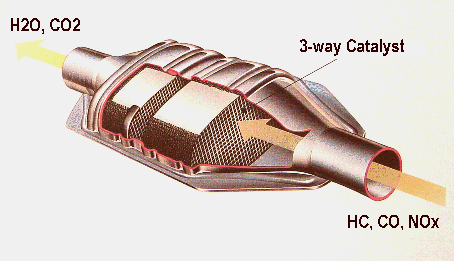
"With its honeycomb construction, a monolith substrate consists of a number of relatively small “tubes” or cells through which exhaust gasses pass. The size of the cells and their length determines the amount of restriction and to some degree, the extent of catalyzing action.
...
Over the years, various brick densities have been used, with the most common now being 300 and 400 cells per square inch. All other dimensions being equal, converters with 100- or 200-cell densities offer improved air flow capacity, but reduced emissions control efficiency. In many cases, it's necessary to significantly lengthen a 100 cell converter to achieve the necessary levels of pollutant control. That additional length reduces flow capacity, so it's possible to end up with a 100-cell converter that does not flow as well as a 300-cell model."
"With its honeycomb construction, a monolith substrate consists of a number of relatively small “tubes” or cells through which exhaust gasses pass. The size of the cells and their length determines the amount of restriction and to some degree, the extent of catalyzing action.
...
Over the years, various brick densities have been used, with the most common now being 300 and 400 cells per square inch. All other dimensions being equal, converters with 100- or 200-cell densities offer improved air flow capacity, but reduced emissions control efficiency. In many cases, it's necessary to significantly lengthen a 100 cell converter to achieve the necessary levels of pollutant control. That additional length reduces flow capacity, so it's possible to end up with a 100-cell converter that does not flow as well as a 300-cell model."
Trending Topics



I think cells refer to the honeycomb structure.
__________________
Best Car Insurance | Auto Protection Today | FREE Trade-In Quote
__________________
Best Car Insurance | Auto Protection Today | FREE Trade-In Quote

Thread
Thread Starter
Forum
Replies
Last Post
SON415
Private Classifieds
0
Sep 28, 2015 05:49 AM


