


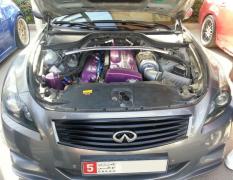
GTM Performance Engineering: VQ37VHR Engine Build 700HP Power Package


We have all seen what the pulley does with the HR and VHR engines it's not worth putting on without proper calibration of the camshaft( from what I've read on this forum and g35driver). Anyway I am really excited to see where this will go and how GTM will handle it.

What I saw nothing wrong,. LOL Are you serious, Looks like a BOMB went off, Just breathing mods?? I've seen a a few blown motors in my time and the only time I saw something this , Was when NO2 goes wrong. :/ IN for build I know Sam is going to do this right.

Administrator
Joined: Aug 2008
Posts: 12,173
Likes: 244
From: Doha, Qatar
Hoooolllyyyy!!
I don't think the pulley has anything to do with it, looks like crazy detonation that broke a piston in half.. and at high rev that thing must've shot out of the bottom end like a bullet
I don't think the pulley has anything to do with it, looks like crazy detonation that broke a piston in half.. and at high rev that thing must've shot out of the bottom end like a bullet

Wow that is some serious damage, the flywheel bolts completely sheared off? That is some serious force. Its hard to tell from the pictures, but at a glance it actually doesnt look like pre-ignition is the cause for this. Generally with engines that fail from pre-ignition, they show evidence of the phenomenon prior to the actual failure. At the same time the cylinder pressures sky rocket, the temperatures do so as well. The shock and heat literally degrade and melt corners or sharper edges of the aluminium pistons and head. One thing to consider is the torsional vibration or resonance characteristics resulting from the Stillen pulley.
Although a billet pulley is good for reducing rotating inertia, I am a strong believer that they only belong on accessories ( AC, PS etc..) This can get pretty involved physics, wise but in a nut shell, your engine's rotating assembly behaves much in the way that your suspension does. Your car's suspension takes a step input (a bump in the road), the spring stores some of the energy, and the damper dissipates it. This spring-mass-damper system is just like an engine's combustion (the bump in the road), pistons-rods-crank (spring and mass)...but where is the damper?! Most OEM Crank pulleys are not solid metal through and through actually. Most have rubber embedded in them or a viscous fluid. The rubber or fluid is the damper.
This may sound far fetched but you'd be surprised what can happen when the rotating assembly in an engine experiences resonance. It could very well end up looking like that poor engine. In any spring-mass-damper system, if you chance one of the components, you change the response of the system to any input. And hey, these engines operate over a frequency range from 0 to 7500rpm... plenty of room for strange things to happen.
Anyways, absolutely nothing against stillen or anything. Just thought i'd bring awareness to the subject. Lack of tuning/knock is the most common reason for engine failure like that.
Although a billet pulley is good for reducing rotating inertia, I am a strong believer that they only belong on accessories ( AC, PS etc..) This can get pretty involved physics, wise but in a nut shell, your engine's rotating assembly behaves much in the way that your suspension does. Your car's suspension takes a step input (a bump in the road), the spring stores some of the energy, and the damper dissipates it. This spring-mass-damper system is just like an engine's combustion (the bump in the road), pistons-rods-crank (spring and mass)...but where is the damper?! Most OEM Crank pulleys are not solid metal through and through actually. Most have rubber embedded in them or a viscous fluid. The rubber or fluid is the damper.
This may sound far fetched but you'd be surprised what can happen when the rotating assembly in an engine experiences resonance. It could very well end up looking like that poor engine. In any spring-mass-damper system, if you chance one of the components, you change the response of the system to any input. And hey, these engines operate over a frequency range from 0 to 7500rpm... plenty of room for strange things to happen.
Anyways, absolutely nothing against stillen or anything. Just thought i'd bring awareness to the subject. Lack of tuning/knock is the most common reason for engine failure like that.


Question from a n00b here, so if one does have the NA combination of intake + HFC + CBE (OEM pulley tho) but does not have a tune performed on the car is there a high percentage chance that something like this could occur? I want to have the car tuned, I just don't have the funds for it right now  . I'd rather put back the stock components until I have the funds for the tune or just not drive the car until it is safe to do so. Any advice would be appreciated.
. I'd rather put back the stock components until I have the funds for the tune or just not drive the car until it is safe to do so. Any advice would be appreciated.

Registered User
Joined: Nov 2011
Posts: 8
Likes: 0
Wow that is some serious damage, the flywheel bolts completely sheared off? That is some serious force. Its hard to tell from the pictures, but at a glance it actually doesnt look like pre-ignition is the cause for this. Generally with engines that fail from pre-ignition, they show evidence of the phenomenon prior to the actual failure. At the same time the cylinder pressures sky rocket, the temperatures do so as well. The shock and heat literally degrade and melt corners or sharper edges of the aluminium pistons and head. One thing to consider is the torsional vibration or resonance characteristics resulting from the Stillen pulley.
Although a billet pulley is good for reducing rotating inertia, I am a strong believer that they only belong on accessories ( AC, PS etc..) This can get pretty involved physics, wise but in a nut shell, your engine's rotating assembly behaves much in the way that your suspension does. Your car's suspension takes a step input (a bump in the road), the spring stores some of the energy, and the damper dissipates it. This spring-mass-damper system is just like an engine's combustion (the bump in the road), pistons-rods-crank (spring and mass)...but where is the damper?! Most OEM Crank pulleys are not solid metal through and through actually. Most have rubber embedded in them or a viscous fluid. The rubber or fluid is the damper.
This may sound far fetched but you'd be surprised what can happen when the rotating assembly in an engine experiences resonance. It could very well end up looking like that poor engine. In any spring-mass-damper system, if you chance one of the components, you change the response of the system to any input. And hey, these engines operate over a frequency range from 0 to 7500rpm... plenty of room for strange things to happen.
Anyways, absolutely nothing against stillen or anything. Just thought i'd bring awareness to the subject. Lack of tuning/knock is the most common reason for engine failure like that.
Although a billet pulley is good for reducing rotating inertia, I am a strong believer that they only belong on accessories ( AC, PS etc..) This can get pretty involved physics, wise but in a nut shell, your engine's rotating assembly behaves much in the way that your suspension does. Your car's suspension takes a step input (a bump in the road), the spring stores some of the energy, and the damper dissipates it. This spring-mass-damper system is just like an engine's combustion (the bump in the road), pistons-rods-crank (spring and mass)...but where is the damper?! Most OEM Crank pulleys are not solid metal through and through actually. Most have rubber embedded in them or a viscous fluid. The rubber or fluid is the damper.
This may sound far fetched but you'd be surprised what can happen when the rotating assembly in an engine experiences resonance. It could very well end up looking like that poor engine. In any spring-mass-damper system, if you chance one of the components, you change the response of the system to any input. And hey, these engines operate over a frequency range from 0 to 7500rpm... plenty of room for strange things to happen.
Anyways, absolutely nothing against stillen or anything. Just thought i'd bring awareness to the subject. Lack of tuning/knock is the most common reason for engine failure like that.
Registered User
Joined: Nov 2011
Posts: 8
Likes: 0
Question from a n00b here, so if one does have the NA combination of intake + HFC + CBE (OEM pulley tho) but does not have a tune performed on the car is there a high percentage chance that something like this could occur? I want to have the car tuned, I just don't have the funds for it right now . I'd rather put back the stock components until I have the funds for the tune or just not drive the car until it is safe to do so. Any advice would be appreciated.
. I'd rather put back the stock components until I have the funds for the tune or just not drive the car until it is safe to do so. Any advice would be appreciated.

Thanks for the advice, I'll look into getting it done at the earliest opportunity.

Registered User
Joined: Jul 2010
Posts: 246
Likes: 2
This is crazy and scary at the same time because like 60% of us are running close to the same set up, I know I am (tp, stillen g3, cbe) but I have it Uprev tuned, I was running lean at first with the intake on but the Uprev guys fixed that. I am very curious to know how this car was driven though, I try and take it easy on my car but we all know there is time we like to get into it, I can't wait to see the finish product on this build


Wow that is some serious damage, the flywheel bolts completely sheared off? That is some serious force. Its hard to tell from the pictures, but at a glance it actually doesnt look like pre-ignition is the cause for this. Generally with engines that fail from pre-ignition, they show evidence of the phenomenon prior to the actual failure. At the same time the cylinder pressures sky rocket, the temperatures do so as well. The shock and heat literally degrade and melt corners or sharper edges of the aluminium pistons and head. One thing to consider is the torsional vibration or resonance characteristics resulting from the Stillen pulley.
Although a billet pulley is good for reducing rotating inertia, I am a strong believer that they only belong on accessories ( AC, PS etc..) This can get pretty involved physics, wise but in a nut shell, your engine's rotating assembly behaves much in the way that your suspension does. Your car's suspension takes a step input (a bump in the road), the spring stores some of the energy, and the damper dissipates it. This spring-mass-damper system is just like an engine's combustion (the bump in the road), pistons-rods-crank (spring and mass)...but where is the damper?! Most OEM Crank pulleys are not solid metal through and through actually. Most have rubber embedded in them or a viscous fluid. The rubber or fluid is the damper.
This may sound far fetched but you'd be surprised what can happen when the rotating assembly in an engine experiences resonance. It could very well end up looking like that poor engine. In any spring-mass-damper system, if you chance one of the components, you change the response of the system to any input. And hey, these engines operate over a frequency range from 0 to 7500rpm... plenty of room for strange things to happen.
Anyways, absolutely nothing against stillen or anything. Just thought i'd bring awareness to the subject. Lack of tuning/knock is the most common reason for engine failure like that.
Although a billet pulley is good for reducing rotating inertia, I am a strong believer that they only belong on accessories ( AC, PS etc..) This can get pretty involved physics, wise but in a nut shell, your engine's rotating assembly behaves much in the way that your suspension does. Your car's suspension takes a step input (a bump in the road), the spring stores some of the energy, and the damper dissipates it. This spring-mass-damper system is just like an engine's combustion (the bump in the road), pistons-rods-crank (spring and mass)...but where is the damper?! Most OEM Crank pulleys are not solid metal through and through actually. Most have rubber embedded in them or a viscous fluid. The rubber or fluid is the damper.
This may sound far fetched but you'd be surprised what can happen when the rotating assembly in an engine experiences resonance. It could very well end up looking like that poor engine. In any spring-mass-damper system, if you chance one of the components, you change the response of the system to any input. And hey, these engines operate over a frequency range from 0 to 7500rpm... plenty of room for strange things to happen.
Anyways, absolutely nothing against stillen or anything. Just thought i'd bring awareness to the subject. Lack of tuning/knock is the most common reason for engine failure like that.
Nice to see you on here Mike. I'll be following this thread closely.